
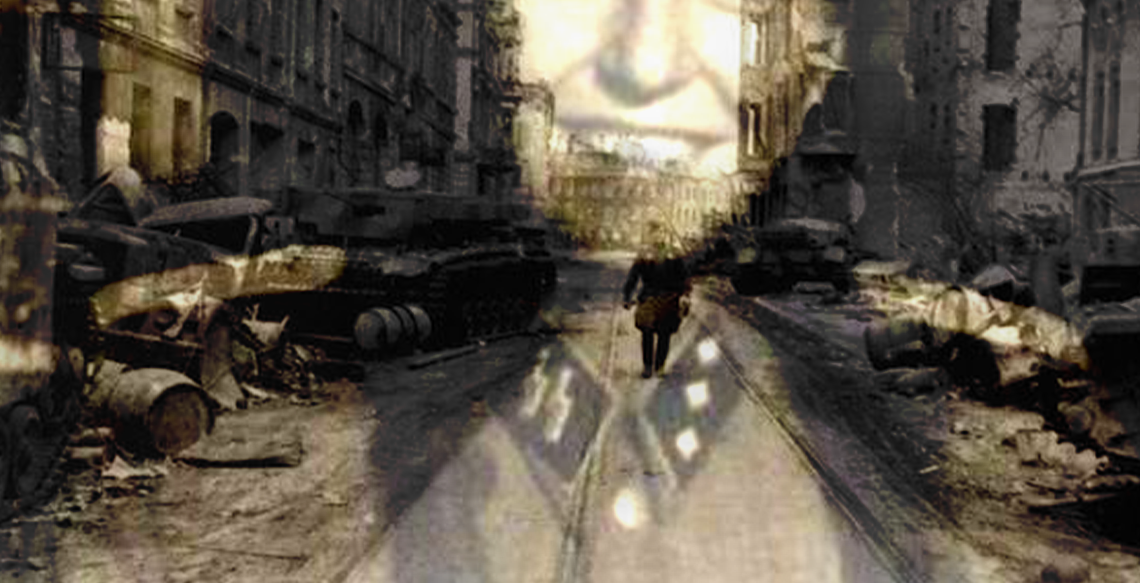
Gerta crouched at the corner of the weathered stone barn. She looked back toward the trees to discover the truck now sitting on the road at the top of the rise, clearly visible from the farmhouse. Obergefreiter Pielen had stayed safely with the vehicle, as always. She could see Margot and Ruth sitting with him, both women too sick to be of much use as scavengers. The cab would not be warm, and the man would stink, but the wind, at least, would not bite.
Coming from behind through the knee-deep snow, Sophie stumbled into Gerta, forcing her to lurch out of the protection of the barn. The wind hit her full in the face, nearly blowing her backwards.
“Be careful,” hissed Gerta as she scrambled out of sight again. “They’ll see us.”
Jutta, Obergefreiter Pielen’s favorite, stood right behind Sophie, making sure the youngest women did what they were told to do, making sure they didn’t eat all the food, if there was any to be found, and making sure they didn’t run away.
They were already running away. The lot of them. From Posen. From the Russians. Three days before, Obergefreiter Pielen had been ordered to take the unit’s five women and flee the front lines. The Red Army’s 8th Guards had surrounded the Polish city, and as bad as things were then, with the constant shelling, it would only get worse for the women once the Russians overran the crumbling defenses. The battered truck, an open flatbed, was the only vehicle the commander could spare for the mission, a mission to get the women 300 kilometers west to Berlin, or at best out of sight when they were killed. Obergefreiter Pielen was the oldest among three hundred doomed men, and he was chosen to steer the women home in the middle of February because he was as useless as the old truck. Gerta, the unit’s map clerk, was not useless. She had found a faint twist of road that would transport them between enemy divisions, breaching the siege.
Gerta rubbed her dripping nose against the coarse sleeve of the gray coveralls she wore over two thick sweaters her mother had knitted for her. Surviving on a dwindling diet of potatoes and horsemeat, she often felt too small, too weak for the task at hand. The fighting for her life. Her cropped brown hair had been covered by a black wool cap for months. She didn’t feel like a young woman anymore. She hadn’t bathed since Christmas.
A thin thread of smoke blew sideways as it escaped the chimney of the farmhouse. Gerta prayed it was a simple peasant family inside, not partisans waiting for a chance to avenge the burning of their village or the raping of their daughters. Gerta had witnessed both over the last months, and the dread of reprisal against her, a simple map clerk, made her shiver as much as the hard wind down her neck.
“Go!” ordered Jutta.
Gerta reached inside a large pocket of her coveralls for the automatic pistol her best friend, Fritz, had given her when he heard the women were to be sent into the wild. The pistol scared her with its weight and intimacy. Fritz, a thoughtful boy who had never tried to kiss her or touch her with his cold hands, had taken Gerta behind a disabled tank and let her pull the trigger twice, then showed her how to engage the safety. After two rounds, she knew what to expect of the automatic: the kick, the roar, the savageness. The Walther’s magazine held eight rounds. Fritz had no more bullets to give. After firing it twice she knew she would have to kill only when she had no choice. A bullet for each of the girls, to spare them. One for Obergefreiter Pielen, if necessary. The last for herself.
Gerta folded back the top of her right-hand mitten so she could tightly clasp the striated pistol grip with her numb fingers. After taking a deep breath, she darted from the edge of the barn to a small wooden cart, where she knelt and watched for movement at any windows on the side of the farmhouse, wanting nothing more than to be drinking tea in her small student apartment in Berlin.
Gerta’s father was a respected shop owner in the city of Gelsenkirchen and a local Nazi Party official. His youngest daughter, a bright, serious girl, had quickly become the leader of the local cell of the Band of Deutsche Maidens, relishing her education in the skills of outdoor life. She had learned to build a fire without matches, to swim like a fish, to hike for ten miles at a time while identifying the trees that rustled around her, to use a compass, but nothing had prepared her for the bitter cold, the bloody flesh, the screams and stink of battle. At age 14 she had left the BDM, with its growing political pressure and cruel behavior toward girls who wouldn’t join. She’d mostly quit because, and she didn’t mind telling her father, she had grown a brain.
Gerta would turn twenty in a month. Wilhelm, the love of her young life, had disappeared near Stalingrad. She had tried to escape the war by enrolling as a philosophy student at the University of Berlin, but in 1944 there was no philosophy which could keep a student safe. When the war turned completely against her nation, Gerta was plucked from the classroom as the child of a loyal Nazi and offered the choice of either working in a munitions factory or being sent to a Waffen SS Unit at the Eastern Front. At home in Gelsenkirchen, her mother had gone crazy, her sister had become the whore of a high-ranking Nazi. Her father spoke of nothing but Hitler. The Eastern Front seemed far enough away from home.
As she crept to the stone fence, her heart pounding, boots crunching on windswept gravel, Gerta saw a curtain move. She had been spotted. Dropping to the snow, she looked back to see Sophie now at the cart, and Jutta waving at her to move forward to the house.
Jutta was a big, blonde, lusty farm girl, who had slept with any number of men in the unit, and she hated Gerta because Gerta was a middle-class city girl with the beginnings of a good education and a bright prospect before the war had destroyed her future. Higher in rank than any of the other girls, and relishing her power, Jutta had once slapped Gerta after catching her giving a drink of water to a prisoner waiting for interrogation. Circling her after making her stand at attention, Jutta then stated in front of a group of smiling officers that Gerta was a dry, sexless girl, and that all useless students that men found dry and sexless would have to be shot in the head at the edge of a pit in order to keep the blood of the Fatherland strong and pure.
The only thing to do was to run to the door. Gerta was so cold, her hand beginning to go dead, that she stood up and walked toward the house in full view of the inhabitants. She disengaged the safety at the side of the pistol, wondering if a bullet to the chest would bring her a peaceful warmth as she slipped away.
Opening the door with her left hand, holding the pistol at arm’s length, she entered the front room of the house. No one shot her. Never seeming to breathe, Gerta moved past a dining room that lay in disarray. She could see that this was a successful farmer’s home. The cupboard and sideboard contents had been disgorged, everything not attached to something else had been cast onto the floor, dishes shattered. A tablecloth lay sideways across the heavy wooden table and it was stained with blood. Gerta took a deep breath and stepped into the kitchen.
A girl, perhaps fourteen, hung by a rope around her neck from the exposed beam in the kitchen ceiling. Slowly turning. The front of her dress was torn and there was blood where Gerta had expected to see it. What she had not expected was that the leg would twitch.
Glancing up, Gerta saw that the eyes were open, the face just going purple. Placing the pistol on the table, Gerta quickly picked up the chair that had been kicked over by the girl, jumped onto it and grabbed her around the waist, lifting her up, taking the weight off her neck. The girl began to gurgle, then coughed, her arm knocking off Gerta’s cap.
“Sophie! Sophie!” screamed Gerta. “Come here! Come!”
Within seconds, Sophie dashed into the room, her hands covering her mouth when she saw the scene. Behind her came Jutta, who chuckled, then knocked the chair over again, causing Gerta to hang from the girl’s waist for a second before dropping to the floor. Smiling up at the twisting girl, Jutta grabbed the feet and began to pull on them, quickening the process of death while the girl waved her arms. As Jutta turned to smile at Sophie, Gerta shot her in the face.
Nearly deafened by the explosion, Gerta quickly righted the chair and strained to hold the girl up again. Sophie stood with her mouth open, frozen, spattered with Jutta’s blood.
“Sophie!” shouted Gerta, her hands clasped around the Polish girl’s waist, her arms aching. “Cut her down!”
Snapping to life, Sophie pulled the table next to the girl and took a folded knife from her pocket. Climbing onto the table, she cut through the limp rope, helping Gerta ease the girl onto the table. Gerta then loosened the knot, pulling it over the girl’s head. A doctor’s assistant in the field hospital, Sophie began to massage the red ring around the girl’s neck.
“What about Obergefreiter Pielen?” Sophie asked, looking at the red mess that was Jutta’s face. “He’ll have heard the gunshot.”
Gerta grabbed the pistol and left the farmhouse.
As she approached the truck, Obergefreiter Pielen stepped out onto the running board.
“What happened?” he asked. “Where is Jutta?”
Gerta pointed toward the house. When Obergefreiter Pielen glanced to see what she was pointing at, she fired the pistol up at him, through the ribcage under his arm. With a cry, he fell to the ground, kicked at the snow with his boots, then began to crawl toward the side of the road. Gerta raised her pistol to finish him off, but realized she couldn’t afford to waste a bullet on the useless man. Looking into the cab, she noted the damp grey look of Ruth’s face, her eyes half closed as she shivered on the seat. Margot did not look much better, hacking a dry cough, her red-rimmed eyes wide open. She understood what was happening. Moving around to the other side of the truck, Gerta opened the door. Ruth nearly slid off the seat, but Gerta held her up. Margot, her once-pretty face turned toward Gerta, shook uncontrollably.
“How are you feeling, Margot?” asked Gerta, the pistol tight in her hand.
“It’s typhus, I’m sure. The hospital is crawling with lice.”
Both dying women were nurses.
“Will you make it to Berlin?” asked Gerta. She thought of the camps, and rumors that thousands of women had died of typhus.
“No,” said Margot.
“Very well,” said Gerta as Margo closed her eyes. “I’ll give you peace.”
***
Gerta set the brake and climbed out of the truck after parking it behind the farmhouse. She had often driven a small truck to make deliveries from her father’s shop. It gave her pleasure to wind through the tree-lined streets of Gelsenkirchen, and on Sunday afternoons the truck gave her and Wilhelm freedom for picnics in the woods, swimming in the lake, and kissing under the tall beech trees.
Leaping from the running board as she slammed the door, Gerta scurried past a small outbuilding, eager to get inside the farmhouse. A group of crows hopped playfully at the corner of her eye, and then she spotted blood on the snow. Scattering the birds, she saw the bodies of the remainder of the farm family lying stiff next to each other. The girl’s mother and father and two young boys. A Russian patrol would certainly have raped the girl to satisfy their animal needs, thought Gerta, but why not the mother? No, it was German men fleeing Posen who did this. Two, maybe three deserters. Death’s Head warriors running toward Berlin. One girl had been enough for them.
As she looked at the bodies, wanting desperately to bury them, to hide them, she saw herself in her generation’s mad, hopeless run for home. Then she thought of Goethe, and the quote of his that she’d mumbled every day since joining her unit.
We do not have to visit a madhouse to find disordered minds.
***
“I heard the gunshots,” said Sophie, holding the Polish girl’s hand.
“Ruth and Margot were suffering terribly,” said Gerta as she spread her map on the table. “And we won’t have to ride in the back of the truck anymore.”
“There were three shots.”
“So?”
“You frighten me,” said Sophie. “Your coldness.”
“It’s winter and men are closing in on us,” said Gerta. “Will we ever be ourselves again?”
“What do we do with the girl?”
“We’re taking her with us. She has no one now.”
“Her family might come back for her.”
“Her family is lying in the snow behind a shed. No one is coming except more men. We’ll take her to Berlin. I have a small apartment there. My aunt owns it, but it’s mine to use and I know where she keeps the key. I’ll hide the girl until the war is over.”
“And me?” asked Sophie, a smile opening up her freckled face. “I have no family to go to.”
“You, too. There’s room for all of us.”
Sophie, barely twenty, her head ringed by frizzy red hair, hugged Gerta.
“Danke, my friend.”
“We must find food, Sophie,” said Gerta as she wriggled from the embrace. “Can she speak?”
“No. She understands my German, but her throat is damaged. And she’s in shock. She might speak again, but it will take time.”
“Then we must find whatever food they’ve hidden by ourselves.” Gerta looked out of the nearest window, then at the map. “You keep your eyes on the road. I’ll search for food. We can’t stay long. It will take us two hours to get to the fuel depot at Rzepin and night is coming.”
After a lengthy search throughout the house, Gerta moved to the barn and finally found a cache of potatoes hidden under a thick blanket of hay. Many were rotten, but she was able to carry enough good ones into the farmhouse that it made sense for Sophie to risk more smoke by boiling water on the stove.
While Sophie tended to the potatoes, Gerta helped the Polish girl out of her soiled clothes. After cleaning her with warm water and a rag, she went to Jutta’s stiff body, which had been dragged outside, and stripped her of her coveralls and identity papers. The Polish girl was blonde, and though much thinner in the face than Jutta, she would fool the sort of soldier left behind at a fuel depot.
They ate in darkness, deciding to leave the farmhouse early the next morning after crowding together for warmth under a pile of heavy comforters in the parent’s bedroom.
At dawn, Sophie helped the girl into the truck while Gerta, in the driver’s seat, held the precious map open in her lap.
They had just pulled onto the road when a truck appeared behind them. Sophie strained to look out the rear window as the vehicle closed the space between, flashing its headlights. Gerta could tell it was not a German truck and pressed her foot heavily onto the gas pedal. The truck behind her was probably filled with men and would be slow to maintain the chase. As she rounded a corner, she spied a narrow track off to the left. Swerving quickly down the trail, bouncing over a rock and spilling Sophie onto the floor, she spotted a Russian truck ahead, surrounded by armed soldiers already crouching to fire. Stomping on the brakes she brought the vehicle to a shuddering halt. She had not evaded the first Russian truck, and it approached from behind. Sophie looked up at her.
“What is it?”
“Russians,” said Gerta, pulling the pistol out of her pocket. “In front and behind. No way through the trees. We’re done.”
“Bitte,” said Sophie, tears in her eyes. “Please.” She lowered her face against the seat, still on the floor of the truck.
“Everything is hard before it’s easy,” said Gerta, thinking of Goethe again before she shot her friend through her curly red hair.
The men stopped their advance at the sound of the pistol, which reverberated throughout the surrounding forest. Sophie crumpled fully onto the floor, blood running out of her head in a pumping stream. The pistol smoked in Gerta’s hand, the cab filling with the smell of blood and urine, and she knew she’d been caught up short when she looked at the Polish girl, who pushed back against the seat, her eyes closed tightly.
Our planet is the mental institution of the universe.
Turning the gun on the girl, Gerta sent the last bullet into her head. The girl jerked to the side from the force, blood splattering the rear window.
Opening the door, Gerta threw the empty pistol onto the road and raised her hands. The rising sun broke through the trees to shine brightly on her face. She closed her eyes to it and imagined the warmth from the portable electric heater in her small apartment when she would lie on the floor and read late at night for exams in front of the radiant glow. Perhaps, she thought as the men approached in their furry hats and thick coats, perhaps they wouldn’t kill her when they were done with her, and she could find the way home to the small apartment, her books, and her better self.


 by
by 

Russell Thayer
Latest posts by Russell Thayer (see all)
- Mercy’s Conscript - April 19, 2021
0 Comments