
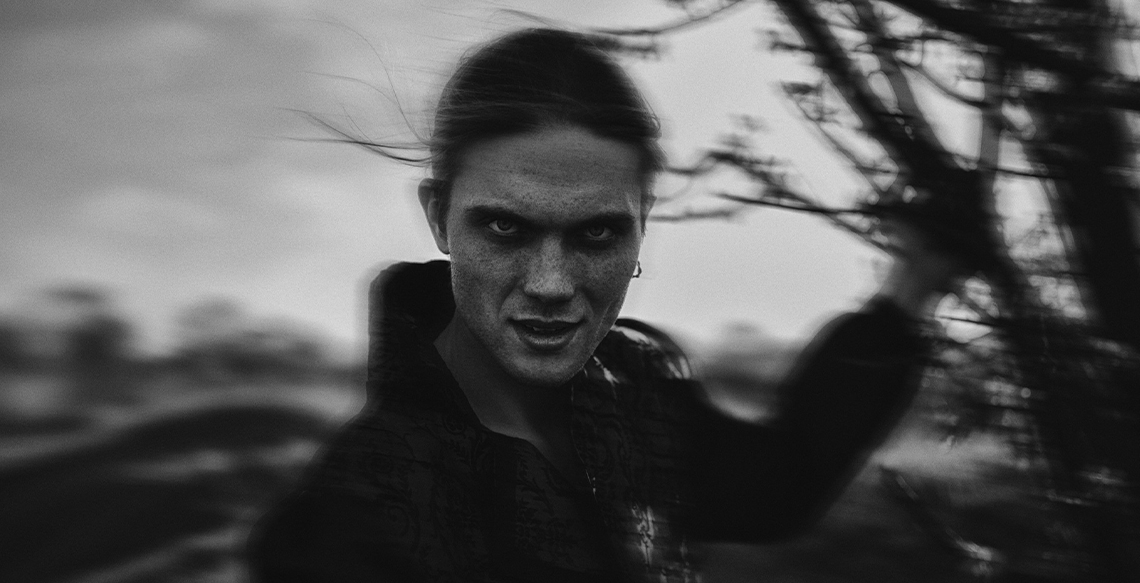
Lewis Lassater was ten years old when he died, which is an awkward age to be a vampire undead. Old enough to recognize irony, too young to be taken seriously by immortals who had seen empires rise, fall, and be replaced by chain restaurants.
He lived in the depths of an abandoned coal mine in West Virginia, sharing subterranean real estate among fourteen vampires who referred to themselves—without irony—as the Family. Their coffins were arranged like pews in a church no one attended anymore, each filled with soil hauled lovingly from ancestral homelands: Transylvanian soil, Balkan clay, Carpathian loam, and a suspicious amount of dirt labeled simply “Old Country, Don’t Ask.” Of course, everyone asked about it, and no one answered.
The owner of that particular coffin, a gaunt vampire named Boris who only ever hissed in response to direct questions, would just glare with eyes like tarnished silver coins.
Lewis’s own coffin was a hand-me-down, a slightly splintered oak number that had once belonged to a vampire named Reginald who’d met his final end via a poorly timed sunbeam and a malfunctioning pocket watch. His soil was from a potting mix bag purchased at a 24-hour garden center in Beckley, a fact that filled him with a perverse sense of pride. It was labeled “Premium Organic Blend for Acid-Loving Plants.” He figured he qualified.
His nightly routine was a study in pre-teen immortal frustration. While the elder vampires would rise with a certain gothic gravitas, sweeping their capes and murmuring about the scent of decay on the evening air, Lewis would erupt from his coffin like a jack-in-the-box, usually banging his head on a low-hanging timber.
“Ugh. Again?” he’d groan, rubbing his forehead. “You’d think after eighty years I’d remember the beam.”
Vladimir, a vampire who claimed to have been a boyar and wore his mustache with immense solemnity, would frown. “The young one lacks decorum. The rising is a sacred ritual. It is the rebirth into the world of shadows.”
“It’s the getting out of bed,” Lewis corrected, brushing coal dust from his eternally clean “Nice Try, Dirt” t-shirt. “And my world of shadows currently smells like wet dog and regret. Who fed on the Johnson’s bloodhound again?”
The Family’s existence was a precarious, cobweb-laced comedy. Their hunting grounds were the dwindling towns surrounding the mine, places where the most exciting nightlife was the fluorescent buzz of a Walmart parking lot. The elders, creatures of ancient forests and castle keeps, were hilariously inept at navigating modern America.
One evening, a vampire named Elspeth, who had the delicate features of a porcelain doll and the temperament of a wolverine, returned from a hunt in a state of high dudgeon. “The mortals have armored their livestock!” she shrieked, flinging a crumpled object to the mine floor. It was a nylon dog jacket, brightly colored with reflective stripes, chewed through at the neck.
“That’s a Pekingese, Elspeth,” Lewis said, poking it with a toe. “And its ‘armor’ says ‘Princess Fluffybutt’. You’ve traumatized a therapy animal.”
“It was yappy and corpulent! A worthy foe!” she insisted, but the other elders shook their heads, muttering about declining standards.
Lewis’s role, unofficially, was that of translator and tech support. He was the only one who understood that the glowing rectangle Mortimer carried wasn’t a soul-stealing artifact but a smartphone with a cracked screen. He had, after much pleading, been allowed to salvage an old battery-powered radio from the county dump. It was his window to the world, his source of news, pop culture, and, most importantly, material.
He listened to talk radio, comedy podcasts, and late-night shows, absorbing the rhythms of sarcasm and satire. He’d then practice his delivery in the dark, his audience a colony of blind cave crickets.
“So, Vlad,” he’d imagine saying. “You lament the fall of the Ottoman Empire, but you still can’t figure out the clasp on a seatbelt. Priorities.”
The central tension of Lewis’s existence was his relationship with the Family’s de facto leader, a vampire named Alistair Finch. Alistair was over seven hundred years old, spoke in a languid, aristocratic drawl, and was perpetually disappointed. He was disappointed by the lack of mist in the Appalachian hollows, disappointed by the taste of modern blood (“It has a faint, metallic top note of processed sugar and existential dread”), and profoundly disappointed in Lewis.
“Your glibness is a defense against the sublime terror of eternity,” Alistair told him one night as they perched on a rusted mining cart, watching the others debate the merits of hunting near the sewage treatment plant.
“My glibness is a defense against the crushing boredom of listening to Gregor debate the best way to haunt a grain silo for the fourteenth night in a row,” Lewis replied. “Spoiler: it’s ‘not at all.’”
Alistair sighed, a sound like wind through a crypt. “You have no reverence. We are creatures of legend, of poetry and fear. We are the whispers in the dark.”
“Right now, Boris is whispering in the dark because he’s trying to read the instructions on a bottle of SPF 100 sunscreen he ‘liberated’. He thinks it’s a potion for day-walking. The legend is fading, Alistair. It’s got a ‘Check Engine’ light on.”
The crisis that finally cemented Lewis’s status—not as a respected elder, but as a desperately needed specialist—began with a zoning permit.
A bright orange notice was nailed to the boarded-up mine entrance. It declared the land had been purchased by “Mountain Mist Leisure & Adventure Co.” and was slated for development into an “authentic Appalachian paranormal experience center.”
Panic, of a particularly undignified sort, swept through the Family.
“We are discovered!” wailed Magda, wringing her bony hands. “They will come with torches and… and zoning boards!”
“We must unleash a plague of nightmares upon them!” thundered Gregor, striking a dramatic pose that was undermined by the “World’s Okayest Grandpa” mug he was drinking blood from.
“Or,” Lewis said, snatching the notice and squinting at the fine print in the dim light, “they’re a tacky tourist trap. Look. ‘Phase One: The Vampire’s Lair Escape Room.’ ‘Phase Two: Bat-Zipline Adventure.’ They’re not coming to kill us. They’re coming to monetize us.”
The distinction was lost on the elders. The concept of an escape room was parsed as a form of sophisticated, sunlit prison. The idea of a zipline was interpreted as a newfangled siege engine. A council of war was called.
Alistair presided, his face grim. “We must fight. We must defend our sanctum with every ounce of our ancient power. We shall be as a tide of fury and fang!”
“Great plan,” Lewis interrupted. “And when the first construction worker with a cell phone camera films Elspeth getting her cape caught in a cement mixer, we’ll be trending on TikTok by dawn. #FloridaMan’sGothCousin. Our sanctum will be a viral meme.”
The elders stared at him, baffled and irritated. “What is this ‘TikTok’? A new form of exorcism?” Vladimir asked.
“Worse,” Lewis said. “It’s where fun goes to die, and then gets made into a dance challenge. We can’t fight them head-on. We need to out-annoy them.”
A skeptical, hissing silence followed. But with no better ideas—Gregor’s suggestion of summoning a legion of giant moths had been vetoed—they reluctantly agreed to let the “whelp” try his scheme.
Lewis’s plan was a masterpiece of petty, pre-teen supernatural sabotage. Using his knowledge gleaned from radio shows and discarded newspapers, he became a one-vampire bureaucratic haunting.
That night, he stole into the site manager’s trailer. He didn’t drink a drop of blood. Instead, he carefully, meticulously, rearranged all the paperwork. He filed the environmental impact survey under “F” for “Fake News.” He paperclipped all the invoices together in reverse chronological order. He used a red pen to circle seemingly random OSHA regulations and wrote “LOL” in the margins. He then unplugged the coffee maker and hid the filters.
The next day, chaos ensued. The foreman, a man named Dale, spent three hours looking for a non-existent “bat mitigation permit” Lewis had invented on a sticky note.
Night two, Lewis targeted the porta-potties. He didn’t tip them over. That was crude. He simply swapped the signs on the doors, so “MEN” and “WOMEN” were reversed, and then lightly superglued all the toilet paper rolls to their dispensers.
By the third night, his operations grew bolder. He used his small, nimble fingers to slightly unscrew every other bulb in the string of construction lights, creating a disorienting strobe effect. He reprogrammed the digital clock in the trailer to display military time and chime like a cuckoo clock every fifteen minutes. He replaced the site blueprints with an elaborate, beautifully drawn diagram of a giant squirrel obstacle course, labeled “Squirrellympics 2024.”
The mortal workers were not scared. They were infuriated, confused, and increasingly convinced the site was cursed by a poltergeist with a degree in administrative assistance and a wicked sense of humor. Productivity ground to a halt. Dale was on the phone constantly, yelling about gremlins in the grading reports.
The Family watched from the shadows, initially contemptuous of these “childish pranks.” But as the construction delays stretched from days into a week, then two, a grudging respect began to form.
“The mortal foreman wept today,” Mortimer reported, impressed. “He cried out to the heavens, ‘Why won’t the PDFs open in the right order?!’ A more potent curse than any wasting fever I have known.”
The climax arrived with the corporate inspector from Mountain Mist Leisure. A man in a too-tight polo shirt named Chad arrived to assess the “unforeseen delays.” Lewis knew this was the final boss.
As Chad sat in the trailer, fuming over the squirrel blueprints, Lewis enacted his magnum opus. He had spent the previous night meticulously learning the trailer’s Wi-Fi password (“Dale1!”). Now, from the safety of a nearby drainage pipe with a stolen tablet, he connected.
First, he changed the desktop background on Chad’s laptop to a high-resolution photo of a particularly judgmental alpaca. Then, he set every single document font to Comic Sans. He remotely ordered 1,000 glow-in-the-dark plastic fangs to the site address, next-day delivery. Finally, he used a text-to-speech app to have the trailer’s Bluetooth speaker softly play “Yakety Sax” on a loop whenever Chad tried to speak.
Chad lasted twenty minutes. He fled the trailer, swatting at the air as if besieged by invisible bees, yelling into his phone about “hostile etheric entities” and “non-compliance with brand synergy.”
The next morning, the bright orange notice was replaced by a new one. “PROJECT INDEFINITELY SUSPENDED DUE TO SITE-SPECIFIC ANOMALIES.”
The Family was saved. Not by fury, or fang, or fear, but by expertly applied nuisance.
That night, a strange celebration was held in the mine’s deepest chamber. The elders, for once, did not lament the old days. Magda had even attempted to bake a “victory cake” from crushed beetles and mud, which Lewis politely declined.
Alistair Finch approached him. The ancient vampire looked down at the ten-year-old boy in the graphic tee, whose greatest power was a well-timed eye-roll and an understanding of basic office sabotage.
“Lewis,” Alistair began, his voice uncharacteristically hesitant. “Your methods were… undignified. Bizarre. Deeply confusing.”
“Thank you,” Lewis said, waiting for the ‘but’.
“But,” Alistair continued, a ghost of a smile touching his pale lips, “they were effective. You have defended the Family. You have, in your own peculiar way, shown a form of cunning worthy of… well, not of an elder. But perhaps of a tenured nuisance.”
It wasn’t a declaration of respect from the ages. It was better. It was a promotion to Head of Strategic Annoyance.
Lewis grinned, his small fangs glinting in the torchlight. “So, does this mean I get to upgrade from the acid-loving plant soil? Maybe something with more loam? A little perlite for drainage?”
Alistair’s sigh was long-suffering, but it now carried a new note: fond exasperation. “We will… see what can be arranged.”
As the others drifted back to their ancestral soils, Lewis climbed into his hand-me-down coffin. He switched on his radio, tuning it to a easy-listening station, closed his eyes, and smiled. The crickets chirped. Somewhere above, the world of chain restaurants and zoning permits carried on, blissfully unaware of the sarcastic little boy in the mine who had, for now, saved the ancient, awkward, and deeply ironic business of being undead. He was still ten, still not taken seriously, and still stuck with the “Premium Organic Blend.” But for the first time in eighty years, it felt just ironic enough to be perfect.
[Image Credit : Photo by Vitaliy Shevchenko on Unsplash]


 by


M.D. Smith
Latest posts by M.D. Smith (see all)
- Lewis Lassater – Minor Vampire - September 4, 2026
0 Comments