
Memory and bodily sensations seldom tell the same story. Miros told the investigators that he didn’t remember hearing an explosion. When he woke up, he knew only that glass was everywhere and he was deaf.
Earlier that morning, Miros had gotten up with the alarm at the normal time, put on his bath robe, and shuffled out to the front steps to get the newspaper. His neighbor Grimbach, out walking his dog, waved and said, “Good morning.” Miros did the same. He took the newspaper inside, brewed a pot of coffee, and retrieved a day-old scone from the refrigerator. He then took all three back to bed with every intention of enjoying the rest of the morning and his day off. He made himself comfortable with pillows propped behind his back, set the coffee on the nightstand, and read the news. The Yankees were tied with Boston for first place, the Taliban had executed five people in Afghanistan, and Israel was close to a ceasefire agreement in Gaza. After page one, Miros fell back asleep. The next thing he knew he was lying on the other side of the bed and completely deaf.
He opened his eyes. Confused. Frightened. The smell of burnt garlic. He had no idea what had happened, or what could still be happening. An earthquake perhaps. The bedroom door was swaying back and forth. The newspaper, comforter, and pillows were on the floor along with his coffee cup, books, the alarm clock, and a lamp. Broken glass covered the bed and floor. Miros sat up, careful to avoid the glass, and swung his legs over the side of the bed. He didn’t feel the cut to his right foot, but he saw the blood. The clock said “seven-fifty-five.” It was still working. Time hadn’t ended, which for a moment seemed like a distinct possibility.
Miros looked at his body. Everything except his hearing seemed to work. He squeezed his eyes shut to clear the mental fog and briefly wondered if something was wrong with his mind. He bent over, still in his bathrobe, and pulled a small piece of glass from his foot, then slipped on a pair of flipflops, and walked into the living room.
Miros was a man who cultivated order. But on this morning there was none. The room was in total disarray. The large window facing the street had shattered, its double panes blown inward. Pieces of glass were embedded in the walls, the ceiling, the furniture. The sofa and chairs were turned over and pushed across the room. It looked as if a pack of gorillas had ransacked the place. He imagined them smashing his Vietnamese vase against a wall, throwing his plaster sculpture to the floor, and ripping the paintings from the walls. His prized possession, a black and white etching of a gumball machine by Thiebaud, remained hanging on the back wall with a triangular piece of glass sticking through it. Miros reached over the overturned sofa and pulled the shard from the print. He looked around the room, mystified by the senselessness of what he saw. His movements were slow and uncertain. His only rational thought was the simple fact that his familiar world had vanished.
Miros walked to the open space that had been his front window. Outside on the street he saw smoldering chaos, black smoke corkscrewing upwards, the acrid smell of burning plastic, flashing headlights and taillights on both sides of the street, and a burning car directly across from his apartment. He hadn’t heard an explosion, so none of what he saw registered clearly in his mind. He could see that the burning car had been a light blue Mercedes that was quickly turning black. It looked like the one that was owned by Stemovich across the street. The hood was missing, the front doors open, the windows shattered. There appeared to be a body strapped in the front, its head and neck arched over the back of the seat. He thought he could see another body in the back of the car, smaller, maybe two smaller bodies. It was hard to tell. Smoke poured from the top of the car where the sunroof had been and out the rear window where there was no longer a rear window.
Miros didn’t know Stemovich other than to wave “good morning” or “good evening.” They had never had anything that you would call a conversation. Miros suspected that Stemovich was involved in some sort of criminal activity, but he didn’t actually know. He was aware that such thoughts were his prejudices hard at work. Stemovich was Russian, he was wealthy, he lived in a house that was larger than the entire apartment building in which Miros lived, and he drove an expensive car. Miros also knew that Stemovich came and went at all hours of the day and night. It wasn’t proof of anything, but it had raised suspicions. As a result, Miros had found himself avoiding the man. He also knew that the Russian had two young daughters whom he had met only once. The older one was named Anya, he thought, or perhaps Anna. Their introduction had been a brief encounter weeks ago. Now was the time of morning that Stemovich drove them to a private school somewhere on the west side of the city. The bodies in the back seat had to be those of the girls. But why would someone want to harm them?
All around the car, the street was littered with glass, leaves, branches stripped from trees, and thousands of sycamore seeds that looked like spent ammunition. Miros looked up and down the street. Someone was sitting on a front stoop, three doors down, his head in his hands. He looked to be covered in blood, partially naked, but apparently alive. An elderly couple walked hurriedly by. The man was dressed but the woman wore only a flowered nightgown. Another woman, young and blonde, stood in the doorway of Stemovich’s house, her hands at the sides of her face, her mouth open. She looked as if she was screaming. A couple of people were running toward her. At the far end of the block, a small crowd had gathered. A police car with flashing lights was inching through the crowd. For Miros it was like watching a silent movie, a Hollywood production in which everything was exaggerated. People moved a little too quickly, the smoke billowed a little too darkly, and the fire burned a little too intensely.
Miros thought he heard a noise. Something pounding or banging, perhaps a vibration. Not distinct but persistent. He wondered if the noise was inside his head, then saw something move below him. He leaned through the opening. A hand with a white towel was waving, reaching out as if surrendering or signaling. Most likely his neighbor in the ground floor apartment. Sara something. He thought he remembered her last name being Mills. Then he saw why she was signaling. She was trapped. The bodies of Grimbach and his dog were pressed against her door. Grimbach’s shirt and jacket had been partially torn off, his legs twisted impossibly under his body, his face nearly unrecognizable. But it was definitely Grimbach. He was lying on top of the German shepherd. Hadn’t he just seen him walking by less than an hour ago? He couldn’t imagine someone hurting old Grimbach.
The wind shifted, bringing the plastic smoke into Miros’ lungs. He covered his mouth and nose with the corner of his bathrobe. It was a familiar smell. I’ve been here before, he thought. A mantra looking for a memory. Until he found it. Saigon. August. 1965.
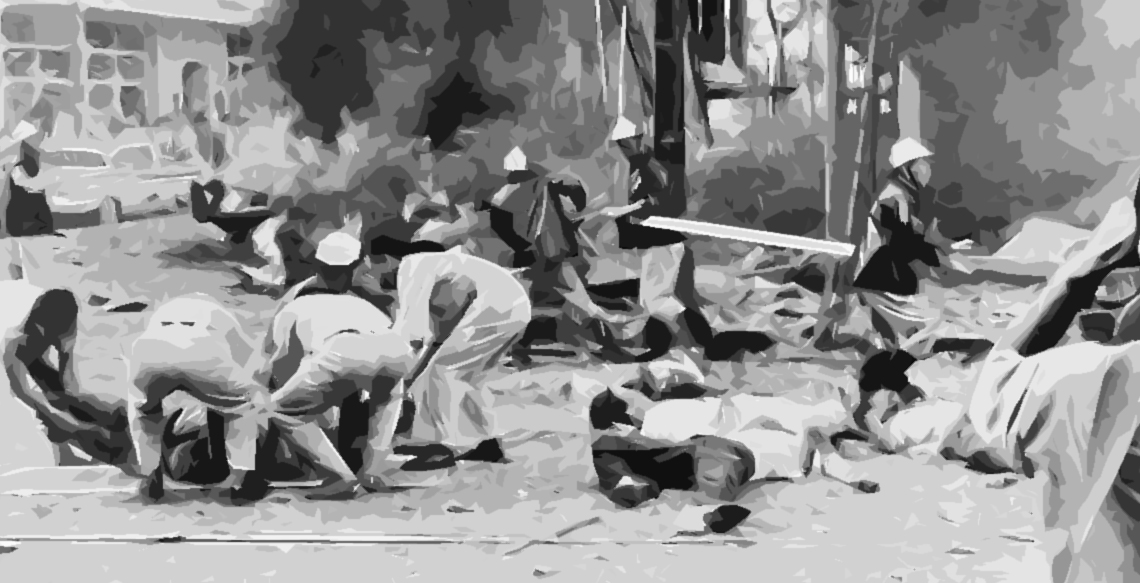
Miros was nineteen, a marine at the embassy. It was his day off. He was eating a late breakfast at a popular restaurant on one of the city’s wide boulevards when it happened. An explosion. An interruption in the frenetic industry of the city. He ran out of the restaurant along with everyone else. In the street he found a swift current of people running and screaming. Miros walked in the opposite direction, against the flow, toward the smoke, like a fish swimming upstream. The closer he got, the more desperate the rush, the more insane the chaos. When he was less than fifty yards away, he saw that the entire front of the National Police Headquarters had been blown away. Bodies were everywhere. Thirty-three dead would be the official tally, a number he would never forget. Thirty-three dead and hundreds injured. Burned bodies, broken bodies, severed limbs.
Miros wiped his eyes and rubbed his face. It was the smoke, he told himself. He heard a sound, thought he heard a sound, as though in a dream. It may have been the car alarms or someone yelling or the woman downstairs or yet another memory. Miros opened his mouth. He waited, listening for his own scream.


 by
by 

Jim Woessner
Latest posts by Jim Woessner (see all)
- Broken Glass - August 6, 2021
- The Coroner’s Assistant - May 17, 2021
- Spilt Coffee - March 5, 2021
0 Comments